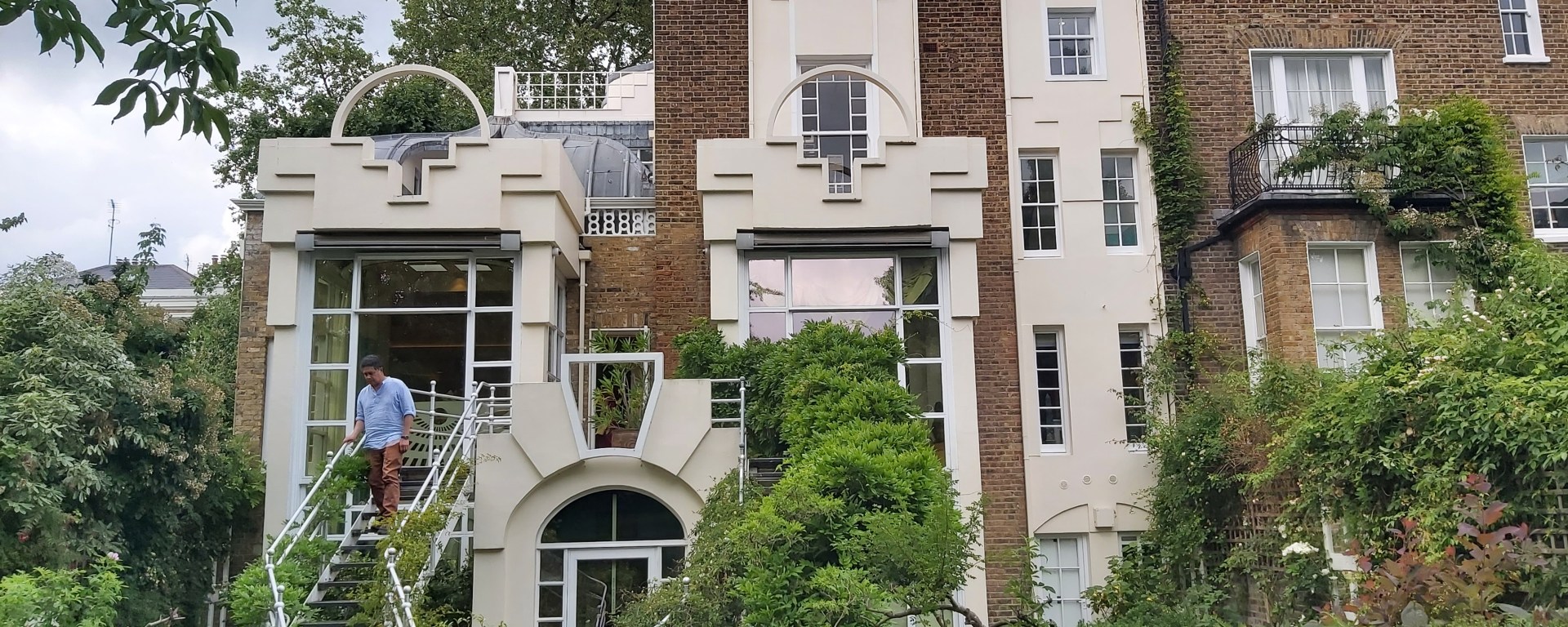
‘Modesty has never been an architectural virtue,’ wrote Charles Jencks (1939-2019), one of many asides in the slim booklet The Cosmic House, which describes the building of that name a few minutes from Holland Park tube station in London. The House is ‘a built manifesto for Post-Modernism… an attempt to create a symbolic architecture for the modern age’.

From the moment that the gates swing open inwards to the entrance – located in what was once the basement – you experience a blizzard of motifs and ideas. The steps on three sides of the entrance form an impromptu waiting area, a mini-lecture space in which a guide introduces the house to you. The double doorknob is Jencks’ aim to introduce symmetry to a mistake that (perhaps not entirely seriously) he believed was a mistake common to the previous 5,000 years of built architecture: ‘The world hasn’t thanked me.’
In the original entrance hall, above an oval arrangement of mirrors, is a frieze with a list of ‘the organisational ideas governing the house’:-
The Cosmic Law Is
Time’s Rhythm Which
Rules Sun & Moon
The Four Seasons Too
Giving Heat & Light
Over All Architecture
Egypt & China Begin
Archetypes & Readymades
The Foursquare Motif
Windows on the World
The 5 Building Arts
In Free Classic Style
Twenty-Two Faces
An Eclectic Whole
Of Personal Signs
Owls, Lilies, Cats, Fix a Place in Time
… And breathe.
Jencks was an influential voice in the Postmodernist movement. The Cosmic House was his own, which he designed with his second wife Maggie (herself a notable designer, with a strong interest in Chinese gardens) and with other Postmodernist architects. The second floor (which is also the top floor, ascending from garden level through the ground and first floors) contains bedrooms for the couple’s children John and Lily and for their nanny.
So this is not just a late 20th-century version of Sir John Soane’s house (as the booklet and the House website suggest). It was also a family home.
Connecting the whole endeavour is the solar stair, a steep spiral staircase with 52 steps, each with seven strips to represent the days of the year. A domed skylight at the top is reminiscent of Soane’s theatrical playfulness with light and space.
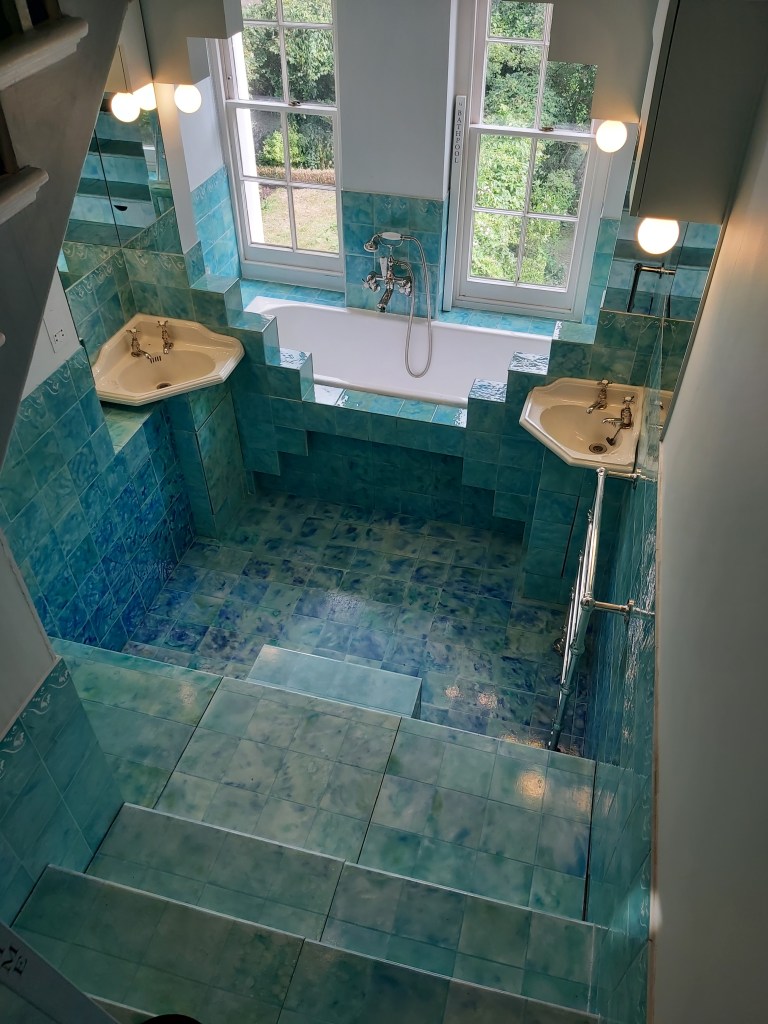
Each visitor will have their own favourite spaces. I enjoyed the notion of the Bathpool, an open space imbuing a bathroom with hints of a grotto, and the Architectural Library in which each bookcase’s shape reflects the subject matter of the books Jencks intended it to contain.

In the garden, a door with mirrored panels beneath an arch bears the description ‘The Future’. It remains to be seen whether Cosmic House survives and thrives in the same manner as Sir John Soane’s house. Jencks wrote a celebratory book about unusual buildings entitled Bizarre Architecture. Perhaps Cosmic House will just slip into that category (to think Jencks had the portmanteau option ‘bizarrechitecture’ and he didn’t use it…)
There is one specific early 21st-century concern that Cosmic House appears not to address: accessibility. I’ve visited historic houses in which those who can’t ascend to higher levels of the building can view photos and video of what’s above them. Could something along those lines not be available here?
That caveat aside, Cosmic House is well worth a visit. Its Postmodern borrowing of ideas and inspiration from all manner of sources – including Classicism, Dadaism, pop art, Egyptology, Art Deco and, as per the house’s name, cosmology – creates an almost infinite range of talking points, without taking itself too seriously.
And it does have one advantage on Soane’s house: you can imagine living here. An open plan bath is, shall we say, daring. But the kitchen, in the ‘Indian Summer’ section of the ground floor and painted in coloured mock marble, is surprisingly practical. In pre-emptive response to any criticism of the decor here – all mandalas and statuettes among the teapots and crockery – Jencks said: ‘If you can’t stand the kitsch, get out of the kitchen’
 Heritage Weekends