The debate within the UK about how far privilege will get you with education and a career may never have been more polarised than now. Whichever way you lean in that argument, it’s hard to argue that Charles Darwin – perhaps the most influential of all Victorians – benefitted from privilege for much of his life.
As we discovered on a visit to his home Down House in Kent, Charles and his wife Emma (who was also his cousin) came from Midlands families with heavyweight intellectual and industrial credentials. For grandfathers they had Eramus Darwin, physician and natural philosopher, and the potter Josiah Wedgwood I. Erasmus and Josiah were friends and fellow members of the Lunaticks – a nickname for the Lunar Society, a collection of scientists and thinkers. One of Erasmus’s sons, Robert, married Josiah’s daughter Susannah, so the families were close even before Charles proposed to Emma in 1838.
By then Charles had long since disappointed his father, a doctor, by neglecting his medical studies in Edinburgh before studying for a BA degree in Cambridge, all the while developing his interests in natural history. John Henslow, a professor and mentor at Cambridge, proposed Charles to join the crew of HMS Beagle on its five-year journey of scientific discovery, an adventure for which his father gave reluctant permission. The journey, and discoveries along the way, changed Charles’ life, although things might have been different; the story goes that he argued so vehemently with the captain about slavery (Charles was not a supporter of that institution) that he was almost put off the ship at one point.
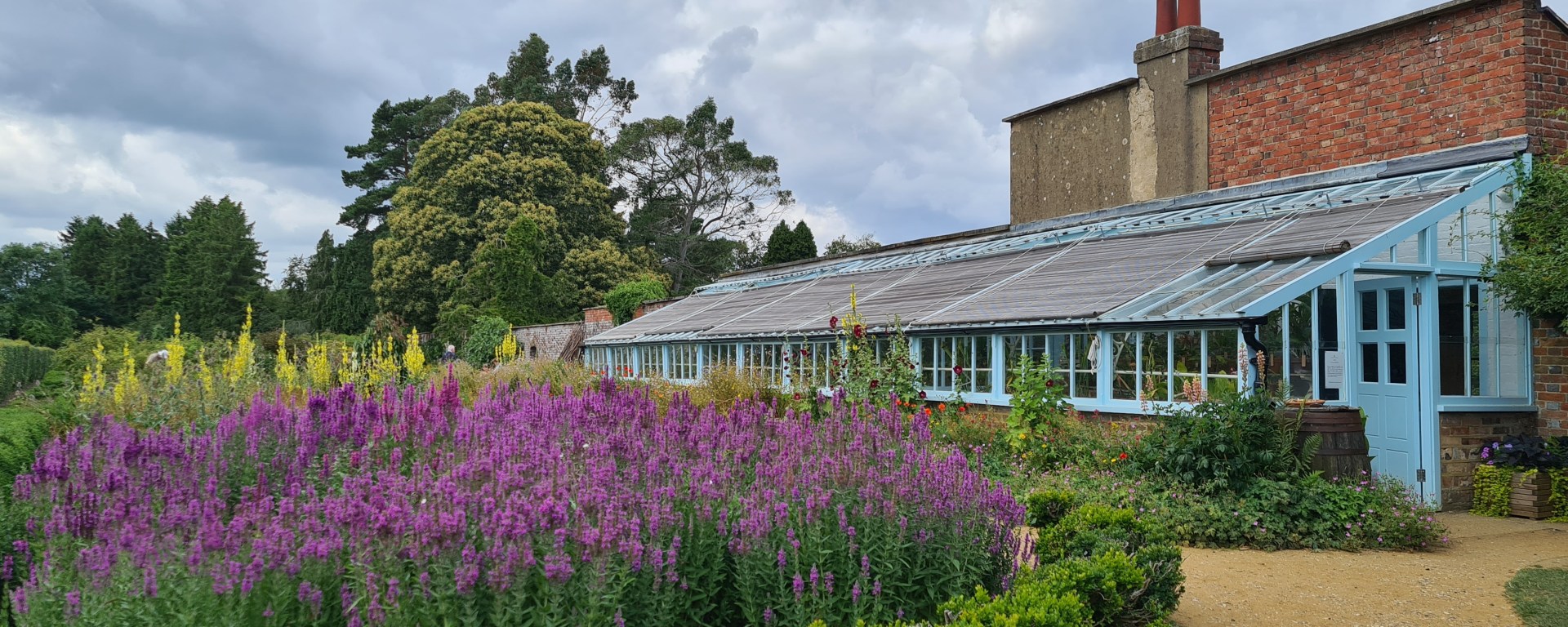
A few years later, Charles and Emma moved to Down House, where Charles spent the next 40 years developing his scientific theories, with occasional interruptions from children (there were ten, though three died young) and help from a small number of domestic staff. The grounds became in effect an outdoor laboratory, along with the greenhouse (pictured) in which Charles cultivated plant specimens and carried out botanical experiments.
The family kept a range of animals which helped to sustain the household with little outside aid. Charles was lucky enough not to have to obtain and fulfil academic posts in order to pay the bills (he wouldn’t get away with that today!) But he did involve himself with the local community as a magistrate and as treasurer of a local friendly society which raised funds for families struck by serious illness or bereavement.
English Heritage now runs Down House and has recreated the ground-floor rooms much as they may have been in Darwin’s day. I particularly liked the billiard room, to which he summoned the butler for a game when the fancy took him. It’s a good example of how comfortable the house must have been to inhabit – in contrast with Darwin’s theories, which caused a great deal of discomfort in influential places at the time…
 Heritage Weekends